|
|
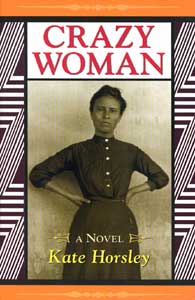
Sara Franklin of Roanoke, Virginia, has been threatened with incarceration in a mental institution by both her father and her husband. But when she is captured by Apaches in 19th century New Mexico and called Crazy Woman, Sara begins to see her so-called insanity as power.
— Lillian Schlissel
Set in the nineteenth-century frontier, Kate Horsley's first novel is about a young, Christian-raised girl who is captured by a band of Apaches after leaving her Presbyterian minister husband for dead. Near starvation as an Apached slave, the book relates how Sara survives, virtually reinventing herself as she sheds the Christianity of her former life, becoming aware, and eventually adopting the life-view and spirituality of her captors. In the process, she grows into womanhood mixing aspects of both cultures that work for her situation. She turns into a powerful—if not quirky—woman and the story unfolds in a refreshing celebration of American individualism . . . Written with compassion and humor, the author weaves the beautiful, the brutal and the benign in a delicate imagery that encompasses the practical, the mystical and the erotic. A gem of a book that should enjoy a wide readership. —R. Gail Miller
Certain books have come into my life in such a way that I can't help but think, This is the perfect time for me to be reading this. I can usually read only before bed or when I wake up in the morning. One day, I was at home on my little ranch in New Mexico and nothing was going on. It was cold outside, so as soon as I got up I padded into the living room, where I have all these bookshelves. On this particular morning, a book called Crazy Woman, by Kate Horsley, caught my eye. I pulled it down, built a fire, and dragged a beanbag chair in front of the fireplace. That was a great luxury - to actually sit down whit a whole day free, start a book, and like it enough to just barrel right through. I got up once, I think, to get a cup of coffee. Other than that, anybody who came by my house that day would have seen me in different postires in this beanbag chair. When I finished, I realized what a joy it is to read books that take place sort of where I am. I could look out at the landscape so similar to the one the author was describing. Of course, sometimes I'm just as grateful to find a book that takes me a million miles away. When I was in Indonesia, everything was so foreign to me - exciting and beautiful but overwhelming. I had brought along Willa Cather's Death Comes for the Archbishop. Reading such an American story made me feel comforted. That's what I mean about timing: I got to read this great Kate Horsley book right there at home. Halfway around the world, I had Willa Cather's novel, which was exactly what I needed then. —Julia Roberts, O Magazine
The story of the young "crazy" woman has stayed with me years after first reading this book. I have read it more than once and recommended it to friends who have all liked it. This young 19th-century girl feels that she must try harder to be "good" by the paternalistic rules of her world. She never feels that she is good enough. The reader follows her spiritual and intellectual growth--as she interacts with "Anglos," Mexicans, Native Americans, and supernatural beings. She perseveres through violence, physical hardships and dealings with ignorance, bigotry, and cruelty. It is a fascinating journey. —A Reader / Amazon.com
Kate Horsley was born in Richmond, Virginia and moved to New Mexico in 1977. She was awarded the City of Albuquerque Award for Excellence in Promoting Cultural Diversity for, Crazy Woman, and for her teaching. Kate Horsley's second novel, A Killing in New Town, was awarded the Western States Arts Federation Prize for fiction in 1996, the New Mexico Press Women's Award, and the Albuquerque Bravo Award. Her other books are: Confessions of a Pagan Nun, (Shambhala, 2001), Careless Love: Or the Land of Promise, (2003,) and the soon to be released, The Changeling of Finnistuath (Shambhala, 2003). Horsley holds a Ph. D in American Studies from the University of New Mexico. Currently, she teaches and serves as Department Chair at TVI, a New Mexican community college and does readings and workshops throughout the Southwest and anywhere else where she can. |